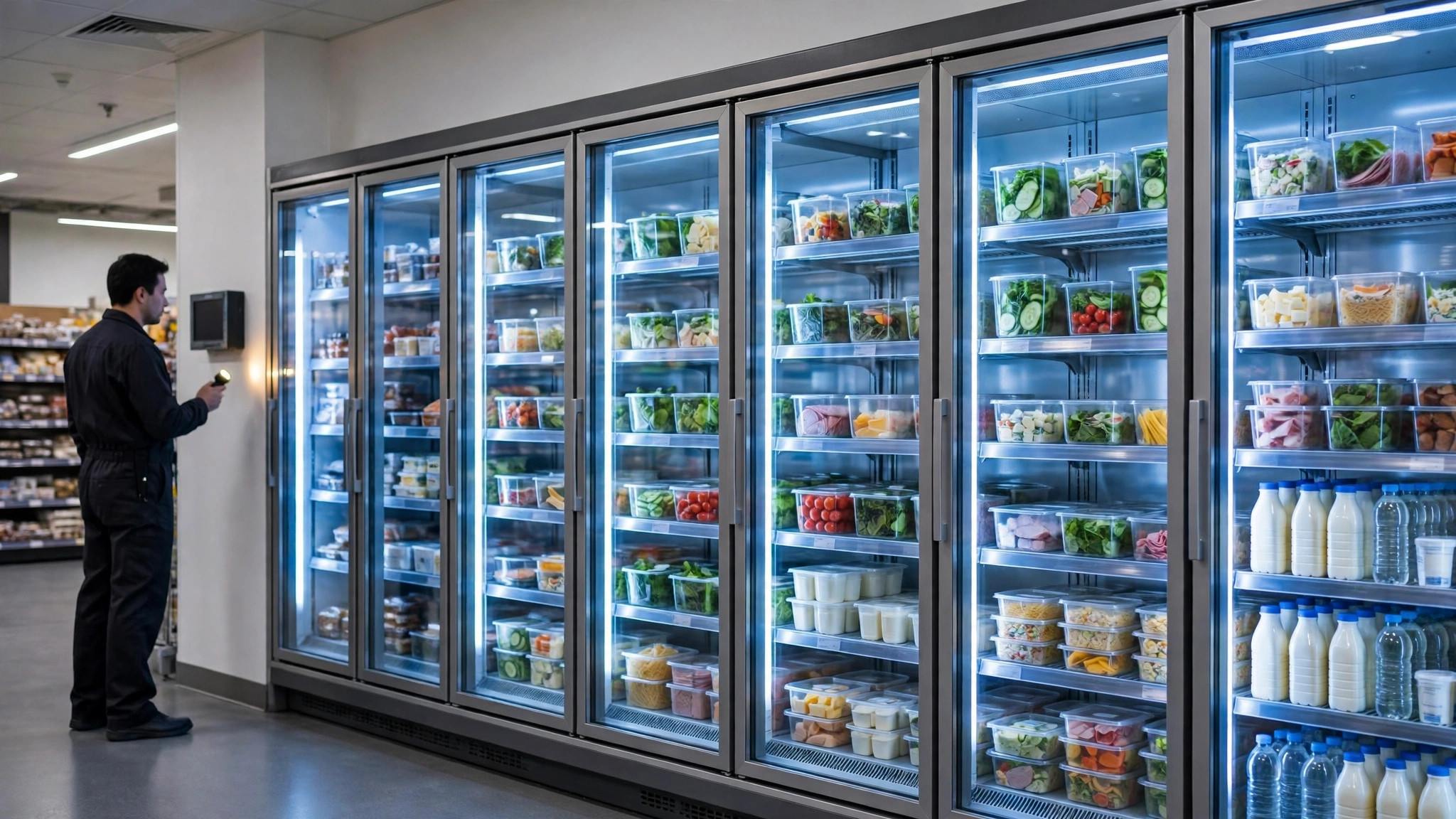
The UK response focused on the systems that control supermarket fridges and other commercial cooling equipment, not on ordinary household refrigerators. Following damaging refrigeration hacks in several European countries, security researchers found a separate potential weakness affecting widely used British control units. Industry teams reduced exposure and manufacturers began issuing updates while the National Cyber Security Centre and other agencies helped coordinate warnings.
What happened in the UK and Europe
On November 20, the BBC reported a behind-the-scenes effort to protect tens of thousands of commercial refrigeration units across supermarkets, warehouses, restaurants, petrol stations and stadiums. The response followed earlier incidents in France and other European countries, where intruders manipulated connected cooling systems and some businesses lost food stock.
The accounts describe several distinct events, not one attack against every British fridge. A UK parliamentary written answer published on November 12 acknowledged that a small number of UK organizations had been affected by the recent cyber activity, with the overall domestic impact described as limited. In contrast, the larger late-October and November preventive operation aimed to protect potentially exposed systems before similar damage could spread.
These distinctions are important for accurate risk reporting. Commercial refrigeration is often managed through specialized control panels that can remotely change temperatures across many units. An exposed controller creates a different kind of risk from a normal smart-home fridge, and discovering a vulnerability is not the same as proving criminals used it.
Which equipment was at risk?
UK supermarkets commonly use equipment from Resource Data Management (RDM), a British provider of refrigeration controls. Continental European attacks had involved other controller families, notably equipment associated with Danfoss. The potential issues identified in the UK are related in their security implications but should not be presented as the identical flaw or the same exploitation campaign.
In a first-person technical disclosure, Pen Test Partners credits Neil McCourt of Omega Solutions with discovering a significant issue in RDM equipment and says its own researchers helped validate and expand the findings. The researchers say this prompted efforts to locate exposed controllers and contact organizations that could be at risk.
The public reports concern operational technology (OT): devices that perform physical business functions rather than simply storing office documents. A controller might supervise multiple refrigeration cabinets and influence whether food or other temperature-sensitive materials remain within their required conditions. That physical consequence is why an otherwise small device-management weakness matters to business continuity.
How researchers and authorities responded
The reported coordination involved security researchers, retailers, refrigeration suppliers, the National Cyber Security Centre (NCSC), the Department for Environment, Food and Rural Affairs and the Food Standards Agency. Industry organizations and company IT teams worked to identify systems that might be accessible from the public internet.
According to the BBC account, thousands of controllers were disconnected from direct open-internet exposure, sometimes through configuration changes and sometimes by disconnecting network access, while staff used manual temperature checks where needed. Security teams were also urged to apply manufacturer mitigations. Researchers have explained that the coordination was initially kept quiet so that potential attackers would not be alerted to the newly discovered risks before operators could act.
The protective measures are not synonymous with switching off refrigeration itself. A business may need to keep cooling equipment functioning continuously while isolating remote management pathways. Any temporary isolation or maintenance should be carried out by its authorized refrigeration and IT professionals with an operational safety plan.
Industry coverage on November 20 reported new RDM firmware releases and said much of the immediate risk had been mitigated among larger operators. It also raised a remaining concern: smaller businesses deeper in food-storage and supply chains may not yet have received or implemented every alert and update. The public information does not establish that every potentially exposed controller has been secured.
What the manufacturer says
RDM has disputed how severe the researchers’ findings were in practical operating conditions, according to the BBC. The manufacturer argued that the reported test went beyond routine procedures and included physical examination of hardware. Its chief executive said the company had moved quickly to respond, issued initial security patches and contacted customers about mitigations.
RDM also stated that it had seen no evidence of malicious activity on its controllers. That position is different from saying no UK organizations experienced refrigeration attacks at all: the parliamentary response acknowledged a small number of affected organizations in the wider cross-European campaign. The identities of equipment involved in individual incidents should not be inferred from broad headlines.
Both the researchers’ risk findings and the manufacturer’s account deserve accurate attribution. A responsible operator should verify the vendor advisory and its own asset inventory rather than assume that either a reassuring statement or an alarming general headline proves its particular configuration is safe or compromised.
Why connected cooling systems are a business risk
Remote management helps maintain temperatures, monitor alarms and support multiple locations. These benefits also create points of contact between ordinary IT networks, outside service providers and physical equipment. Weak access controls or unnecessary public exposure can make a small number of connected systems important to a large number of refrigerated cabinets.
A disruption to refrigeration may affect a retailer’s stock, a warehouse’s deliveries and a business’s ability to continue operating. Temperature excursions can also trigger compliance and quality-review obligations, depending on the products stored. The precise operational impact varies by business and equipment, so incident plans should identify who can safely override or inspect the system when network access is interrupted.
The lesson is broader than one refrigeration vendor. Operational technology often remains installed for years and can have specialized support arrangements. Security programs need a way to discover equipment that is no longer actively managed by the team that originally connected it.
Practical steps operators should take
The NCSC’s guidance on internet-exposed operational technology provides a defensive starting point. It is not a substitute for the model-specific RDM advisory or the judgment of the authorized refrigeration contractor, but its principles apply broadly:
- Inventory controllers and connections. Record the refrigeration control units, sites, approved support vendors, relevant software versions and remote-management paths. Ask whether any controller or its management interface can be reached directly from the public internet.
- Reduce public exposure. Work with the manufacturer or systems integrator to remove unnecessary internet-facing access and use approved private or controlled remote management paths rather than direct device exposure.
- Review account protections. Replace factory or shared credentials with unique authorized accounts, apply multifactor authentication where supported and document who can change temperature settings.
- Apply verified vendor updates. Confirm model compatibility, follow official security advisories and plan firmware changes with operational staff so refrigeration monitoring and alarms remain functional.
- Monitor unexpected behavior. Alert on unexplained administrative access, unexplained network connections, unauthorized configuration changes and suspicious temperature trends.
- Test recovery. Retain configuration backups and confirm that approved staff can restore monitoring and operation after a network incident or device failure.
A business should not automatically disconnect equipment on the basis of a news article. Critical systems can require vendor-managed procedures to avoid accidental spoilage or downtime. Establish responsibilities and an approved change window first, with contingency monitoring if remote connectivity is temporarily restricted.
What is still uncertain?
Several questions remain open in public accounts. The percentage of smaller UK businesses that have received the relevant advisories is unclear. Published information also does not establish that every affected device has applied the latest firmware or undergone independent validation after installation.
There is a separate unresolved question of who carried out the earlier European attacks. Attribution claims have appeared in reporting, but attribution is not necessary to understand the protective measures and should not be presented as settled without strong, independently evaluated evidence.
For the RDM case, the researchers’ account of a potential weakness and the manufacturer’s claim of no observed malicious exploitation can both be true. The UK government statement about limited affected organizations concerns the broader incident context, not proof that the newly documented RDM weakness was exploited.
What businesses can learn
The UK case illustrates how operational security depends on coordination between hardware suppliers, independent researchers, refrigeration operators and public agencies. Rapid warnings and managed network changes can reduce risk before an exploit causes physical damage, but the protections must reach smaller contractors and sites as well as large chains.
For operators of industrial cooling, building controls or other connected equipment, the appropriate next action is to verify the inventory, obtain current vendor security guidance and remove unmanaged public-facing access with expert assistance. The goal is safe continuity of a physical business process, not merely a passing vulnerability scan.