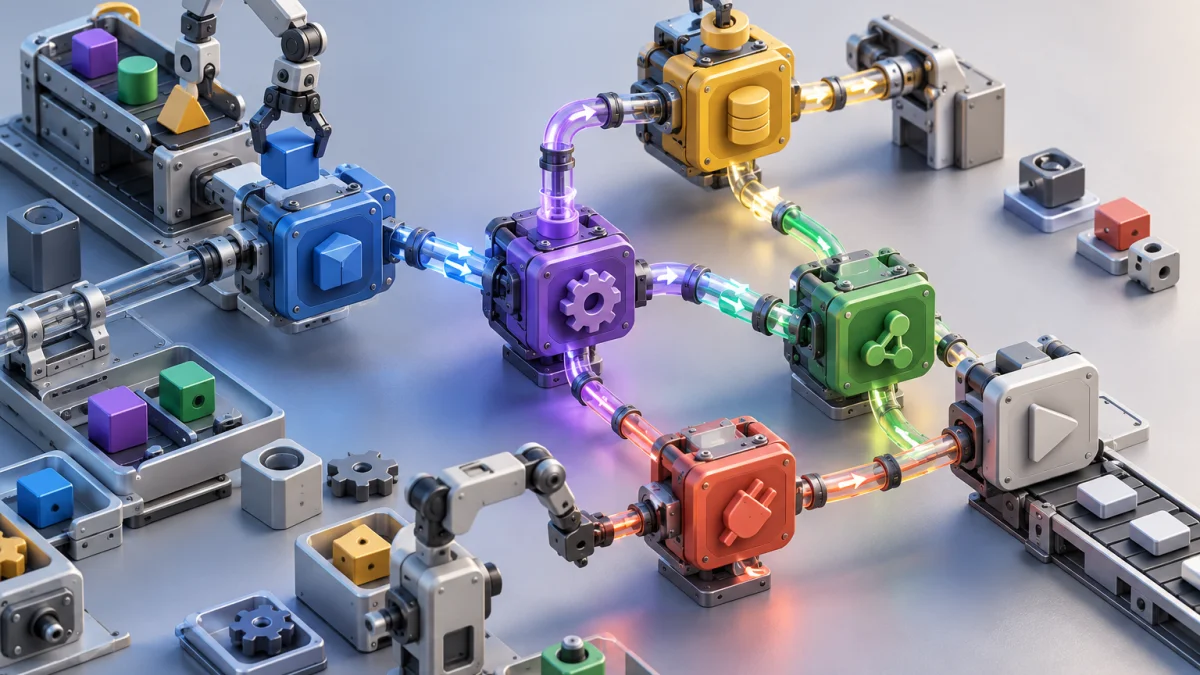
Langflow works best when a team wants to map an AI workflow visually, validate it quickly, and then drop into Python only where the graph stops being expressive. That hybrid model is more important than the drag-and-drop interface itself because it keeps the visual layer from becoming a hard ceiling.
What Langflow is in 2026
Langflow’s current README describes a platform for building and deploying AI-powered agents and workflows. It combines visual authoring with built-in API and MCP servers, support for major LLMs and vector databases, and a growing component/tool ecosystem.
The project is also actively maintained. As of October 8, 2026, the GitHub repository is not archived and the main branch includes a release-1.12.5 merge dated October 6. That matters after Flowise reached end of life in August: maintenance is now a first-order selection criterion for visual agent builders, not a background detail.
| Area | Langflow approach | Why it matters |
|---|---|---|
| License | MIT | Permissive open-source use and modification |
| Authoring | Visual canvas plus Python components | Fast iteration without a permanent no-code ceiling |
| Agents | Multi-agent orchestration, retrieval and tools | Supports more than simple prompt chains |
| Delivery | API, JSON export and MCP server | Flows can become reusable application interfaces |
| Deployment | Desktop, local Python, Docker and cloud infrastructure | Teams can choose the operating model |
Visual builder without a no-code ceiling
Langflow’s strongest architectural decision is allowing developers to customize components in Python. A visual tool is useful when it makes relationships obvious: model input goes here, retrieval happens there, a tool is called next, and the output is transformed before it reaches the user.
But visual abstractions become limiting when a workflow needs unusual validation, domain-specific logic or an integration that does not exist as a prebuilt node. Langflow’s source-code access gives developers an escape hatch rather than forcing them to abandon the platform entirely.
This is especially useful for mixed teams. A product manager or domain expert can understand the graph, while an engineer can implement a custom component behind one node. The result can remain inspectable without pretending every production requirement should be solved by connecting boxes.
The danger is still graph sprawl. Once a flow contains many branches, nested agents and external tools, the visual canvas can become difficult to reason about. Teams should treat flows like software: establish naming conventions, reusable components, source control and environment boundaries.
Agents, retrieval and integrations
Langflow supports multi-agent orchestration with conversation management and retrieval. Its README also emphasizes support for major LLMs, vector databases and a growing library of AI tools.
That makes it suitable for common agent and RAG patterns: an internal assistant that retrieves company documents, an agent that selects among tools, or a workflow that uses multiple model calls and external data sources.
Langflow’s advantage is composability. Instead of adopting one opinionated knowledge-management product, developers assemble the retrieval, model and tool components they want. That can be a better fit for engineering teams that already have a preferred vector store, data layer or model gateway.
The trade-off is more architectural responsibility. A platform such as Dify gives knowledge management a stronger first-class product surface. Langflow gives developers more of a component graph and expects them to decide how those pieces should fit together.
APIs and MCP
Langflow’s current positioning goes beyond “visual LangChain.” Built-in APIs and Model Context Protocol support make each flow potentially reusable outside the authoring interface.
A flow can be deployed as an API endpoint for another application to call. It can also be exposed as an MCP server, turning the workflow into a tool available to compatible MCP clients. That is useful when a team wants one visual workflow to serve several front ends or agent environments.
MCP support is especially relevant in 2026 because agent ecosystems increasingly separate the model from the tools it can access. A Langflow flow can package logic, retrieval and external actions into a reusable tool boundary rather than hard-coding everything into one assistant.
The same capability increases the need for permission design. An MCP tool that can mutate a database, deploy code or update a business system should not receive broad credentials just because the flow is easy to draw.
Testing and observability
Langflow includes an interactive playground for testing and refining flows with step-by-step control. This is valuable because agent failures often occur between components rather than inside one model call.
Developers need to know which input reached the retriever, which tool was selected, what the model returned and which branch executed next. A visual builder is most useful when it helps expose that path rather than hiding it.
The project also supports observability integrations including LangSmith and LangFuse. Those integrations can help teams trace runs, inspect latency and compare behavior across versions.
For production systems, however, observability should extend beyond model traces. Teams still need application logs, infrastructure monitoring, error reporting, access logs and business-level success metrics. Langflow can participate in that stack, but it does not replace it.
Deployment and self-hosting
Langflow provides several ways to run the software. Langflow Desktop packages dependencies for Windows and macOS. Developers can install the Python package locally, run Docker containers, build from source or deploy the open-source project to major cloud environments.
This flexibility is helpful for development teams that want the same core tool across laptops, private infrastructure and production deployments.
Self-hosting should still be evaluated as an operations decision rather than a licensing feature. A production Langflow instance may need a database, secrets management, network controls, backups, upgrades, observability and a deployment pipeline. The software being free does not remove those costs.
For regulated or sensitive environments, self-hosting can improve control over the application layer, but external model providers and vector databases may still receive data depending on how the flow is configured.
Pricing and cost model
Langflow itself is free open-source software under the MIT license. There is no mandatory Langflow license fee for running the core project.
The real costs come from the environment around it: model API usage, vector databases, hosting, storage, monitoring and the engineering time required to operate the deployment. A local proof of concept can be inexpensive; a high-volume production system can cost substantially more even though Langflow itself remains free.
This is different from a managed builder with one subscription that bundles infrastructure and support. The open-source model gives teams more control over architecture and vendors, but budgeting has to include the whole stack.
Third-party hosted Langflow services may have their own fees. Those should be evaluated separately from the Langflow project’s MIT license and current upstream code.
Maintenance status
Maintenance is a major strength for Langflow in late 2026. The repository remains active and the October 6 release activity shows the project is still receiving fixes and releases.
That does not guarantee future continuity, but it distinguishes Langflow from Flowise, whose official upstream reached end of life and was archived in August 2026.
For teams standardizing on an open-source agent builder, current release cadence matters because models, Python dependencies, MCP tooling and external providers change quickly. An active upstream reduces the amount of compatibility work that must be carried privately.
Where Langflow falls short
The first limitation is the same one shared by most visual orchestration tools: complexity eventually becomes a graph-management problem. Visual clarity is strongest for bounded workflows; it degrades when too many conditional branches and agents accumulate on one canvas.
Second, Langflow is not an all-in-one AI application business platform. Teams that want managed knowledge ingestion, publishing, workspace governance and opinionated application lifecycle controls may find Dify more complete.
Third, open-source deployment means operational responsibility. Langflow gives teams the code and deployment flexibility, not a guarantee that their own production environment will be secure, observable or inexpensive.
Finally, model quality still dominates many outcomes. A sophisticated flow cannot compensate for a poorly chosen model, weak retrieval corpus or unsafe tool permissions.
Langflow vs Dify and Flowise
Langflow vs Dify: Choose Langflow when you want a component-oriented visual graph, Python customization and reusable API/MCP interfaces. Choose Dify when you want a broader application platform with first-class knowledge pipelines, app publishing and more opinionated lifecycle management.
Langflow vs Flowise: This comparison changed in 2026 because Flowise reached EOL. For a new deployment, Langflow is the maintained choice between the two official upstream projects. A Flowise fork can still be valid if a team deliberately owns maintenance, but it is not the default recommendation for new work.
Langflow vs code-first frameworks: Code-first tools remain better when every workflow is heavily custom, deeply tested and tightly integrated into a larger software system. Langflow is strongest when visual iteration and shared understanding are valuable enough to justify the graph abstraction.
Privacy, security and responsible use
Langflow can run on infrastructure you control, but privacy depends on every connected component. A self-hosted flow that sends prompts to an external model provider still exposes data according to that provider’s policies.
Protect model keys, database credentials and MCP connections as production secrets. Restrict tool permissions and require human review for actions that are difficult to reverse.
RAG pipelines should enforce document-level permissions and test retrieval against unauthorized queries. Agent tools should be allowlisted rather than given broad access to a production environment.
AiTechJournal reviews agent platforms for legitimate professional, technical and research use. We do not promote deceptive, exploitative or malicious automation. Our AI tool review methodology explains how product facts are separated from editorial recommendations.
Who should use Langflow?
| User | Fit | Reason |
|---|---|---|
| Developers prototyping AI workflows visually | Strong | Fast canvas iteration with Python escape hatches |
| Teams building reusable MCP/API tools | Strong | Flows can be exposed directly through both interfaces |
| Open-source/self-hosted teams | Strong | MIT license and multiple deployment paths |
| Teams wanting an all-in-one RAG application platform | Mixed | Dify offers more opinionated knowledge and app lifecycle tooling |
| Large code-first engineering systems | Mixed | Complex logic may be easier to maintain directly in code |
Langflow review: final verdict
Langflow is one of the better visual agent builders to standardize on in late 2026 because it combines three things that matter: an active upstream project, permissive MIT licensing and a path from visual authoring into real Python, API and MCP integration.
Its value is not that it eliminates code. Its value is that it lets teams start visually and add code where precision requires it.
Choose Langflow if you want an actively maintained visual agent/workflow platform with self-hosting, Python extensibility and reusable application interfaces. Choose Dify if you want a broader AI application and knowledge platform, or move directly to code-first frameworks when visual composition no longer improves clarity.
Frequently asked questions
Is Langflow open source?
Yes. Langflow is released under the MIT license, and the source is available in the public GitHub repository.
Is Langflow still maintained?
Yes. As of October 8, 2026, the repository is not archived and includes release activity from October 6, 2026.
Can Langflow be self-hosted?
Yes. Langflow can run locally with Python, in Docker containers or on major cloud infrastructure. Langflow Desktop is also available for Windows and macOS.
Can Langflow expose MCP servers?
Yes. The project documents built-in MCP server support that can turn a flow into a tool for compatible MCP clients.
Langflow vs Dify: which should I choose?
Choose Langflow for a flexible visual component graph with Python, API and MCP escape hatches. Choose Dify when you want a more integrated AI application platform with first-class knowledge/RAG and publishing workflows.