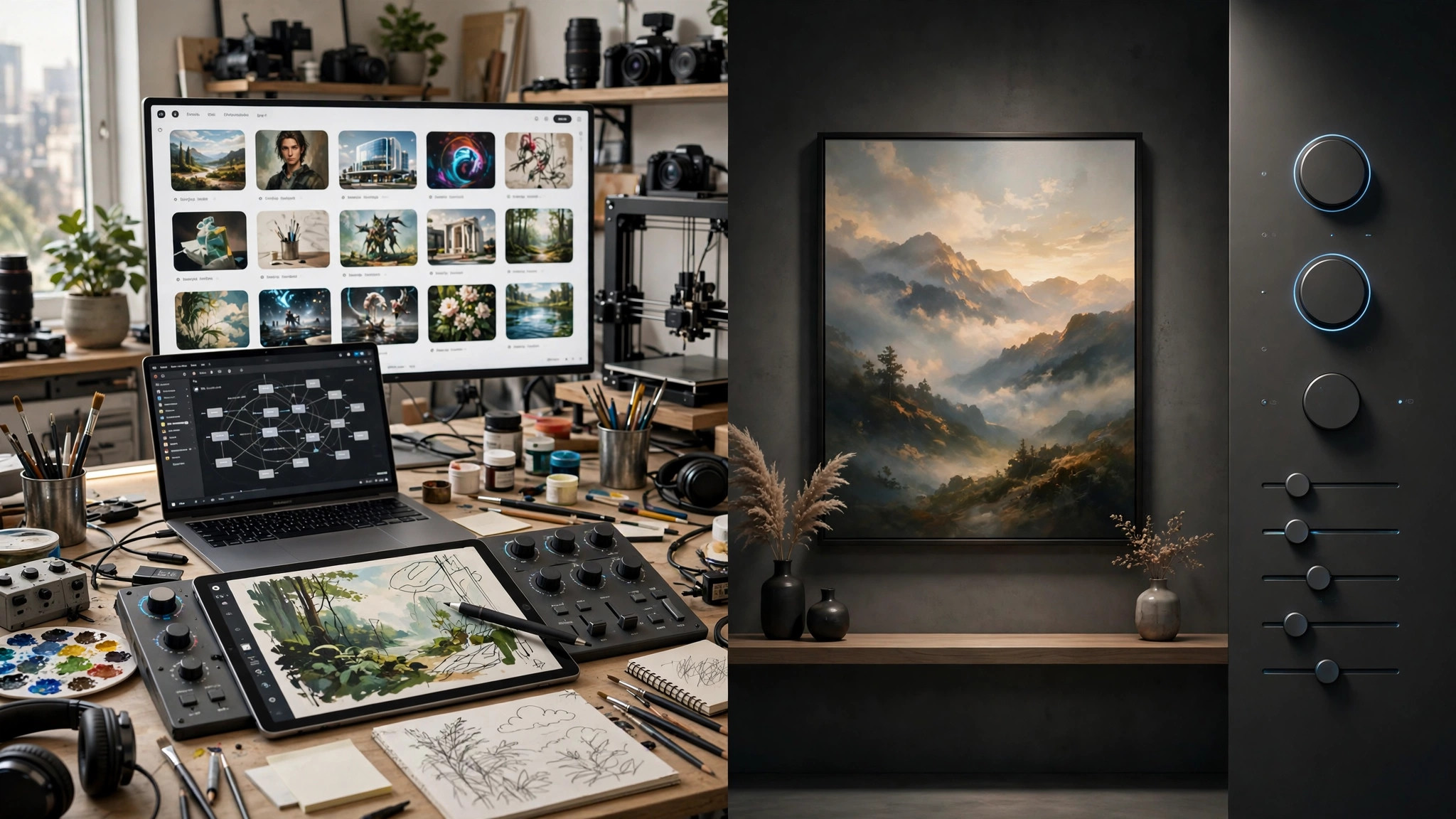
Leonardo AI and Midjourney both generate high-quality images, but they are built around different creative philosophies. Leonardo is the stronger choice if you want a broad creative platform with multiple models, realtime tools, personal model training, private generations and API access. Midjourney is the stronger choice if you want a more focused image-first workflow built around its own V8.2 aesthetic, personalization and style controls.
The short answer
| Need | Better fit | Why |
|---|---|---|
| Broad creative toolset | Leonardo | Multiple models, Realtime Canvas, Elements, Flow State and training |
| Focused aesthetic image generation | Midjourney | V8.2 centers on image quality, aesthetics and personalization |
| Train a personal subject or style model | Leonardo | Paid plans include personal AI model training |
| Style-driven creative exploration | Midjourney | Style References and personalization are core controls |
| Realtime drawing and canvas iteration | Leonardo | Realtime Canvas and Realtime Generation are built into the platform |
| Instruction-based image editing | Both | Leonardo has editing/realtime tools; Midjourney now has the V8.2 Edit Model |
The practical decision is therefore not simply which tool can make the prettier image. It is whether you want a multi-model creative workspace or a focused image-generation environment.
Current platforms in late 2026
Leonardo has evolved into a broad creative AI platform rather than a single image model. Its current plans expose first-party and third-party models, Realtime Canvas, Realtime Generation, Elements, Flow State, presets, private generations and personal AI model training.
Its first-party image lineup includes Phoenix 1.0 alongside Lucid models, while the platform also offers access to third-party systems. That breadth lets creators choose the model and workflow that best fit a particular asset rather than committing every task to one image engine.
Midjourney takes the opposite approach. Its current V8.2 model remains the center of the product. V8.2 launched in July 2026 with emphasis on aesthetics, image quality and improved personalization, and the surrounding workflow is designed to refine that model through style controls, references and editing.
This difference is the foundation of the comparison: Leonardo behaves like a creative toolbox; Midjourney behaves like a focused visual instrument.
Image quality and creative direction
Midjourney’s strongest argument is still creative direction. V8.2 is optimized around its own visual system, and Midjourney’s personalization and Style Reference controls make it straightforward to steer generations toward a consistent aesthetic.
For concept art, campaign imagery, editorial scenes, moodboards and art-direction exploration, that focused environment can be a strength. The user spends less time deciding which model to use and more time refining a particular visual direction.
Leonardo is more flexible rather than more singular. A user can switch between first-party and third-party models depending on whether the job prioritizes realism, style, speed, editing or another production constraint. This is especially useful for teams whose output varies widely across projects.
Our Leonardo AI review examines that multi-model workflow in more detail, while the Midjourney review focuses on Midjourney’s image quality, editing, pricing and limits.
Creative control: canvas tools, Elements and model training
Leonardo has the clearer advantage when the creator wants multiple forms of technical control inside the same platform.
Realtime Canvas and Realtime Generation let users work more interactively than a simple prompt-and-wait loop. Elements add another layer of reusable visual control, and paid plans support personal AI model training. Leonardo says users can train a unique model from a small set of images to reproduce a particular style, subject or theme.
That is particularly useful for recurring characters, products, game assets or brand-specific subjects. Instead of depending only on prompt wording and references, the creator can build a more persistent model-level representation.
Midjourney approaches consistency differently. Personalization and Style References guide new images toward preferred visual characteristics, but the workflow is not organized around training a personal image model in the same way.
For creators who want model-level customization and a wider range of technical controls, Leonardo has the advantage.
Editing workflows
Both platforms now have meaningful editing capability.
Leonardo integrates editing with the broader platform surface. Realtime Canvas, guidance references and image-editing tools make it possible to move between generation, adjustment and refinement without treating every revision as a completely separate generation task.
Midjourney’s V8.2 Edit Model has materially improved its position. It supports natural-language editing instructions, up to four reference images, inpainting and outpainting, and it can combine those edits with personalization, moodboards and Style References.
So the old framing that Leonardo is the editing tool while Midjourney is only for generation is outdated. Both can now support iterative editing. Leonardo still offers the broader editing workspace; Midjourney offers a more focused edit path inside its own aesthetic system.
Style consistency and repeatable subjects
Leonardo and Midjourney both support repeatability, but at different layers.
Leonardo’s personal model training is the stronger option when a creator needs to repeatedly reproduce a specific subject, theme or learned visual identity. Elements and image-guidance features add more control around that trained or selected model.
Midjourney’s strength is aesthetic repeatability. Style References and personalization can push multiple generations toward a shared visual language without asking the user to train a separate model.
That makes Leonardo attractive for character systems, game assets, product subjects and specialized recurring content. Midjourney is attractive for campaign art direction, editorial consistency and visual exploration where the aesthetic itself is the primary object of control.
Platform breadth, API and production use
Leonardo is easier to place inside a wider production system. Its official API covers image, video, 3D and audio models, with pay-as-you-go access and concurrency controls.
That means a development team can use Leonardo not only as a creator-facing web application but also as infrastructure behind custom software, marketing systems, creative automation and product features.
Midjourney’s main value remains inside its own creative environment. This is not necessarily a disadvantage for artists or designers who want a focused tool, but it matters to organizations that need programmatic integration or a single vendor covering multiple media types.
For another example of the focused-tool versus production-platform distinction, see our Recraft and Midjourney comparison.
Pricing, privacy and commercial rights
Leonardo currently offers a free plan with 150 Fast Tokens per day. Essential costs $12 per month, Premium $30 and Ultimate $60. Premium and Ultimate include unlimited relaxed image generation on selected first-party models, while Ultimate also adds relaxed video generation on supported first-party models.
Paid Leonardo tiers include private generations and higher personal-model training limits. The current plan table lists 10 personal model trainings per month on Essential, 20 on Premium and 50 on Ultimate.
Leonardo’s ownership terms also differ by tier. Paid subscribers retain ownership and intellectual-property rights to generated images. On the free tier, Leonardo retains rights to the creations while granting the user a non-exclusive, royalty-free licence for commercial use.
Midjourney currently charges $10 for Basic, $30 for Standard, $60 for Pro and $120 for Mega. Standard and above include unlimited image generation in Relax Mode. Stealth Mode is available only on Pro and Mega, making plan choice relevant when client or proprietary work should remain private.
The price comparison is therefore more nuanced than $10 versus $12. Leonardo includes a usable free tier and broader platform features, while Midjourney Standard can be attractive for creators who value unlimited Relax Mode image generation.
Which tool fits which creator?
| Creator or workflow | Better fit | Reason |
|---|---|---|
| Concept artist focused on visual exploration | Midjourney | Focused V8.2 aesthetic and style controls |
| Game artist building repeatable characters or assets | Leonardo | Personal model training, Elements and broader controls |
| Marketing team using multiple media models | Leonardo | Broad platform plus API and private generations |
| Art director creating moodboards and campaign directions | Midjourney | Personalization and Style References fit exploration well |
| Developer integrating generation into a product | Leonardo | Official production API across multiple modalities |
| Creator who wants a free starting point | Leonardo | 150 Fast Tokens per day on Free |
| High-volume image creator who values Relax Mode | Midjourney | Standard and higher include unlimited Relax Mode images |
Final verdict
Choose Leonardo AI if you want a multi-model creative platform with realtime tools, personal model training, private paid generations and API access. It is the more flexible system for creators and teams that need several kinds of control or production integration.
Choose Midjourney if you want a more focused image-first environment built around V8.2, personalization and style-driven creative exploration. Its narrower platform is also part of its appeal: the workflow revolves around making and refining images rather than managing a large tool stack.
Frequently asked questions
Is Leonardo better than Midjourney?
Leonardo is better for platform breadth, realtime control, model training and API integration. Midjourney is better suited to focused image-first creative exploration and aesthetic direction.
Which one has a free plan?
Leonardo. Its free tier currently includes 150 Fast Tokens per day. Midjourney’s current plans are paid only.
Can Leonardo train custom models?
Yes. Paid plans include personal AI model training, with the monthly training allowance increasing by tier.
Can Midjourney edit existing images?
Yes. The V8.2 Edit Model supports instruction-based edits, references, inpainting and outpainting.
Which is better for private commercial work?
Leonardo includes private generations on paid individual plans. Midjourney offers Stealth Mode on Pro and Mega. Commercial ownership rules also differ, so businesses should review the plan terms that apply to their use.