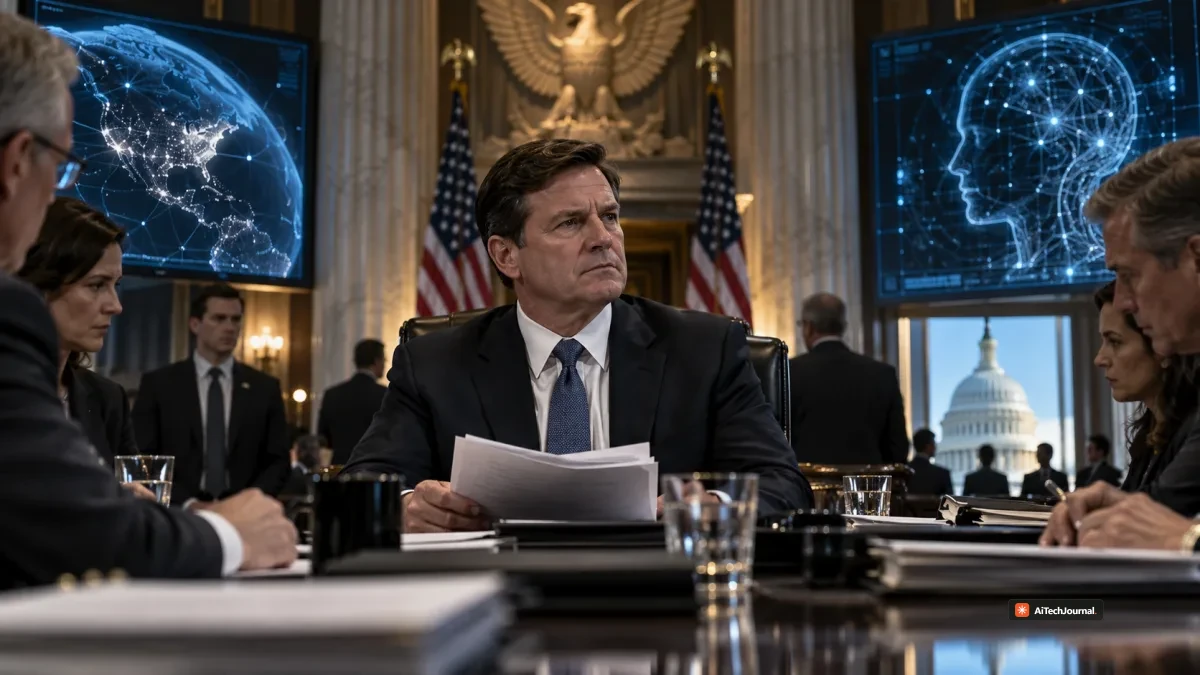
President Donald Trump named Director of National Intelligence Jay Clayton to lead a new federal task force called the Super Intelligence Force on October 4, according to Associated Press reporting on the announcement. The appointment puts a serving intelligence chief at the center of the administration’s AI-policy effort.
The October 4 announcement also places Federal Trade Commission Chairman Andrew Ferguson, Under Secretary of Defense for Research and Engineering Emil Michael, and Office of Personnel Management Director Scott Kupor in leadership roles. The group will report to Trump and White House Chief of Staff Susie Wiles.
Trump said the force will coordinate federal engagement with consumers, public-interest groups, religious organizations, critical-infrastructure providers and companies developing advanced AI systems. The announcement describes a coordination role rather than a new regulatory regime, leaving important questions about the task force’s practical authority and how its recommendations will translate into policy.
The name is significant because the White House has recently changed the language it wants federal agencies to use. A September 29 executive order directs executive departments and agencies to use “Super Intelligence” and “SI” instead of “Artificial Intelligence” and “AI” in non-statutory government communications.
That terminology should not be confused with the technical concept of artificial superintelligence, usually understood as a system that broadly exceeds human cognitive performance. The executive order’s own definition currently ties “Super Intelligence” and “SI” to the existing statutory definition of artificial intelligence. In other words, the administration has changed the federal label; it has not established that machines have reached technical superintelligence.
That distinction matters as the term begins appearing in policy announcements. A reader encountering “Super Intelligence Force” could reasonably assume the government is responding to a newly achieved level of machine capability. The documents available so far support a narrower reading: the force is an AI-policy body operating under the administration’s new terminology.
Clayton’s new responsibilities also shift the institutional center of gravity. The Office of the Director of National Intelligence identifies Clayton as its incumbent director, and the October 4 appointment places him at the head of a separate AI-policy coordinating group. This gives the U.S. intelligence community a direct role in discussions of innovation, cybersecurity, critical infrastructure and national security. The announcement alone should not be treated as a complete description of his future dual-role arrangements.
It is less clear how much independent authority the force will exercise. The announcement identifies its leadership, reporting line and engagement mandate, but it does not by itself create a comprehensive federal AI law or spell out a detailed enforcement structure. For now, the more concrete change is organizational: AI policy coordination is being elevated under a group that spans intelligence, defense, consumer regulation and federal personnel.
That makes the task force’s future outputs more important than the label attached to it. The practical test will be whether it produces concrete coordination mechanisms, policy proposals or guidance that materially changes how federal agencies and AI companies operate. Until then, the announcement is best read as an institutional reorganization around a fast-moving technology rather than a technical milestone.
The White House’s use of “SI” is therefore likely to become increasingly visible across federal policy, but the terminology needs careful handling. For AiTechJournal, the useful distinction is straightforward: “SI” can now refer to the administration’s official label for AI, while “artificial superintelligence” remains a separate technical concept. Treating the two as interchangeable would turn a political naming decision into a claim about machine capability that the underlying policy documents do not make.