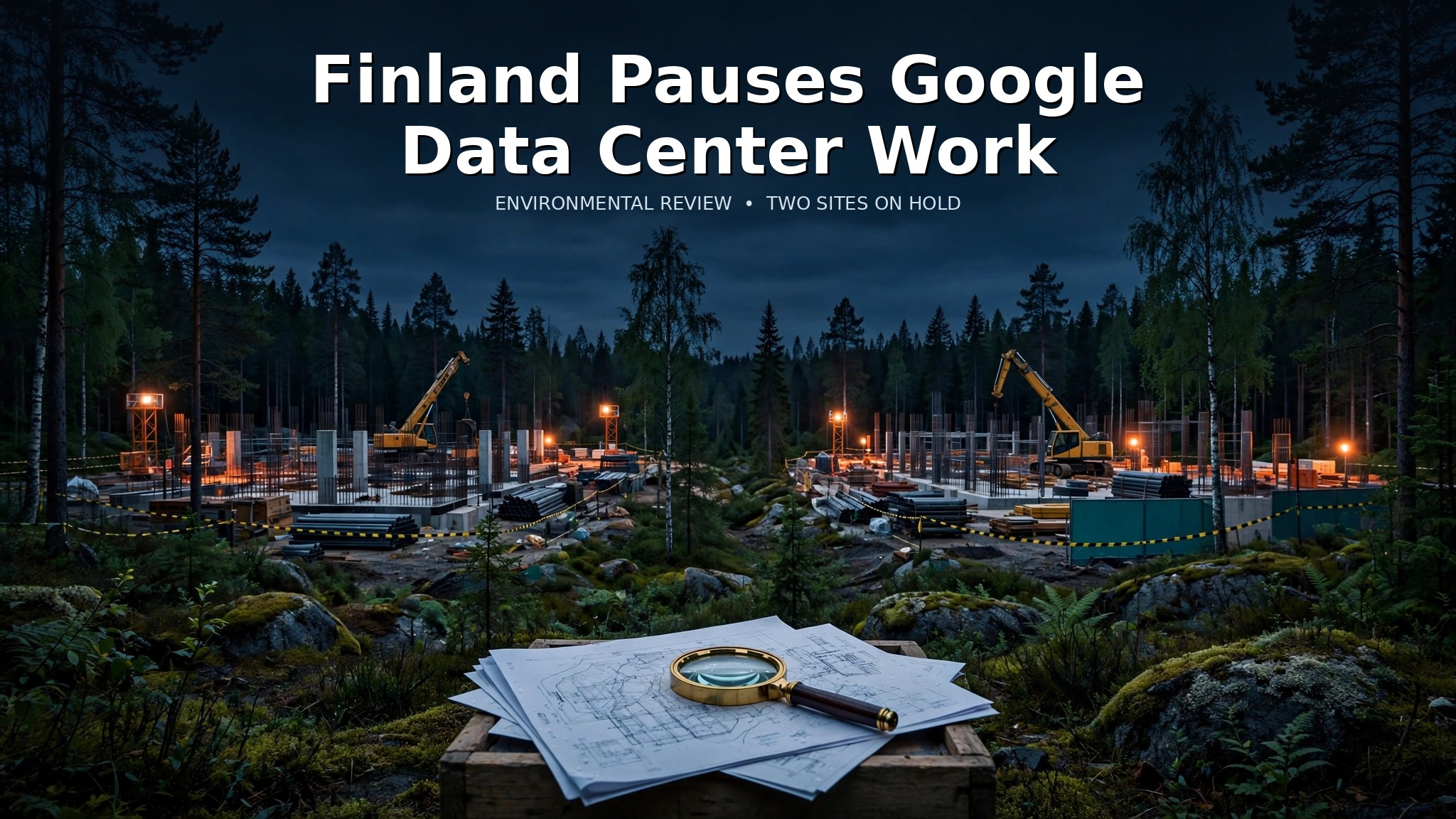
Finland’s Licensing and Supervision Authority has ordered Tuike Finland, the company representing Google on two planned data-center projects, to stop preparatory work that significantly changes the environment at sites in Muhos and Kajaani. The October 6 notice says the affected work must stop immediately and no later than October 23, remaining paused until the projects’ environmental impact assessment procedures are complete.
The wording matters. This is not a blanket order shutting down every activity connected with the two projects. The regulator specifically targeted environment-altering preparatory measures, a narrower category that covers work capable of changing the sites before the environmental review has run its course. Tuike Finland has also been asked to submit a written explanation and say how it intends to proceed.
The order follows scrutiny of work already carried out at the sites. Reporting based on the regulator’s investigation describes tree removal, stripping of topsoil, road construction, storage areas and changes to ditches. The Finnish authority’s concern is that such changes can create the very environmental effects the assessment process is meant to identify and evaluate before irreversible work advances too far.
What the regulator actually ordered
The Finnish regulator’s October 6 notice says Tuike Finland must suspend preparatory measures that significantly alter the environment at the Muhos and Kajaani projects until their environmental impact assessment procedures have been completed. The authority based the notice on Finland’s environmental impact assessment law.
That distinction is important because headlines describing Finland as having “halted construction” can suggest the entire development process has been frozen. The notice is more precise: it focuses on work that materially changes the physical environment. Planning, design, measurements and other activities that do not themselves create significant environmental changes are not described in the notice as being categorically prohibited.
Le Monde, citing AFP, reported that Tuike Finland must provide an explanation by October 14. The authority’s notice sets October 23 as the latest date by which the covered preparatory measures must have stopped. If the company does not comply, the regulator has said enforcement proceedings could follow.
Google has acknowledged the concerns. In a statement reported by multiple outlets, the company said it had fallen short of its own standards, while also saying it had acted in good faith under the Forestry Act and had carried out nature surveys. Google said it would study the authority’s findings and follow its guidance.
The dispute sits inside Google’s €13 billion Finland expansion
Muhos and Kajaani are not isolated projects. In September, Google announced a €13 billion investment in Finland over two years spanning digital infrastructure, clean-energy projects and economic partnerships. Google called it its largest single investment in Europe and tied the expansion to Hamina, Kajaani, Muhos and Vaala.
The scale is one reason the regulatory intervention matters beyond Finland. Demand for AI computing capacity has pushed hyperscalers and specialist cloud operators to secure land, grid access, cooling capacity and construction pipelines years in advance. But compute hardware is only one part of the delivery chain. Environmental review, zoning, power infrastructure and local political acceptance can all determine whether promised capacity arrives on schedule.
AiTechJournal has already tracked how local resistance and community impacts are becoming part of the AI infrastructure equation. Amazon, for example, has pledged more than $1 billion for communities hosting its data centers as the industry faces growing local scrutiny. That broader context helps explain why the Finnish case is significant: even one of the world’s largest technology companies can encounter a hard regulatory stop when site preparation gets ahead of environmental review. See our earlier coverage of Amazon’s data-center community commitments.
There is also a policy contrast with jurisdictions trying to accelerate data-center construction through tax or investment incentives. In the United States, new Opportunity Zone rules may improve the economics of some rural data-center projects, as covered in our analysis of rural data-center tax treatment. Finland’s action shows the other side of that equation: incentives and capital cannot substitute for completing environmental procedures.
The immediate effect on Google’s Finnish buildout will depend on how quickly the environmental assessments are completed and what further action the regulator takes after receiving Tuike Finland’s response. It would therefore be premature to describe the €13 billion program itself as cancelled or broadly suspended.
What the case does establish is a more practical point for the AI infrastructure race. Data-center expansion is increasingly constrained by systems outside the server rack: land-use rules, environmental review, grid capacity, water, community acceptance and the sequencing of permits. As investment totals rise into the tens of billions, those constraints can become just as consequential as access to accelerators.