Claims about machines becoming “smarter than humanity” often compress several different ideas into one headline. A model can beat experts on a test, write fluent software, or operate tools without meeting any accepted threshold for general intelligence. The useful question is therefore not whether AI is improving. It is what kind of capability has actually been demonstrated, under what conditions, and with what reliability.
The short answer
Artificial intelligence is the broad category for machine-based systems that infer outputs from inputs. Most deployed systems remain bounded by their training, tools, interfaces, and operating conditions, even when they can handle many tasks. Artificial general intelligence, or AGI, is a proposed category for systems with broad human-level competence. Artificial superintelligence, or ASI, goes further: it describes a hypothetical system whose general cognitive capability exceeds that of humans across a wide range of important domains.
The sources reviewed for this article describe ASI as a hypothetical category and do not document an independently established ASI system. There is also no single test or certification that turns a capable model into AGI. Progress is real, but a benchmark result, product announcement, or expert forecast is not the same as proof of general or superhuman intelligence.
What artificial intelligence means today
The OECD’s updated AI-system definition focuses on machine-based systems that infer how to produce outputs such as predictions, content, recommendations, or decisions. It also recognizes that systems vary in autonomy and in how much they adapt after deployment.
That definition covers a wide range of technology. A fraud detector, medical-imaging classifier, route optimizer, recommender, industrial vision system, and large language model can all be AI. Their capabilities are not interchangeable. Some are narrow by design. Others are general-purpose in the sense that one model can summarize, translate, code, analyze images, or call tools. “General-purpose,” however, describes a broad interface and range of uses. It does not prove robust competence across every cognitive domain.
Modern models can retrieve patterns from large training corpora, combine concepts, follow complex instructions, and sometimes outperform people on well-defined tasks. They can also fail on unfamiliar variants, accept false premises, produce unsupported details, or behave inconsistently when prompts, tools, or context change. Their output depends on a larger system that may include retrieval, software, human review, policies, and external data. Evaluating the model alone can therefore miss both the strengths and the failure modes of the deployed product.
Where AGI fits between AI and ASI
AGI is best treated as an evaluation problem, not a marketing label. Researchers disagree about whether it should mean human-level performance on most economically valuable tasks, the ability to learn almost any intellectual task, broad competence with limited task-specific training, or some combination of capability and autonomy.
A useful Google DeepMind framework for levels of AGI separates performance depth from capability breadth and discusses autonomy as a deployment consideration. That distinction matters. A system may be exceptional at mathematics and coding yet unreliable in planning, physical reasoning, social context, or novel real-world situations. It may answer questions across many topics but require extensive human correction to complete long projects.
ASI is a more demanding and more speculative category. It is not simply “better AI,” a larger model, or a product that beats people on several benchmarks. A defensible ASI claim would require broad evidence of capability beyond the strongest human individuals or institutions, reliable transfer to unfamiliar domains, sustained performance on consequential work, and a clear account of the system’s autonomy and dependence on human-created tools.
AI, AGI and ASI compared
| Dimension | Current AI | AGI | ASI |
|---|---|---|---|
| Status | Deployed and measurable | Contested proposed category | Hypothetical category |
| Typical scope | One task or a broad set of tasks within designed conditions | Broad human-level capability across domains | Broad capability beyond human individuals or institutions |
| Transfer | Variable; often needs prompting, tools, fine-tuning, or new data | Expected to transfer knowledge across unfamiliar tasks | Expected to transfer at a level exceeding human experts |
| Autonomy | Ranges from passive prediction to bounded agents | Definition-dependent; not automatically required | Often assumed, but must be measured rather than inferred |
| Reliability | Highly dependent on task, environment, and safeguards | Would need broad, repeatable evidence | Would require extraordinary cross-domain evidence |
| Evidence | Products, evaluations, deployments, and documented failures | No universally accepted certification | No established deployment documented in the reviewed sources |
| Decision relevance | Immediate adoption, safety, security, labor, and governance choices | Research planning and preparedness | Scenario analysis and long-range risk management |
The table is deliberately asymmetric. Current AI can be tested against actual systems. AGI and ASI must be described through proposed criteria and conditional scenarios. Treating all three as fixed rungs on an inevitable ladder hides that difference in evidence.
Why stronger benchmarks do not prove superintelligence
Benchmarks are necessary because impressions are unreliable. They make a task, scoring method, and comparison point visible. They are not complete measures of intelligence.
The Stanford AI Index technical-performance review notes that established tests such as MMLU, GSM8K, and HumanEval have become saturated, encouraging researchers to create harder evaluations. Saturation can show that systems have improved, but it also makes an old test less useful for distinguishing frontier capability.
Four limitations matter when a benchmark result is used to support an AGI or ASI claim:
- Task coverage: A test samples a domain. It cannot represent every type of reasoning, judgment, interaction, or real-world constraint.
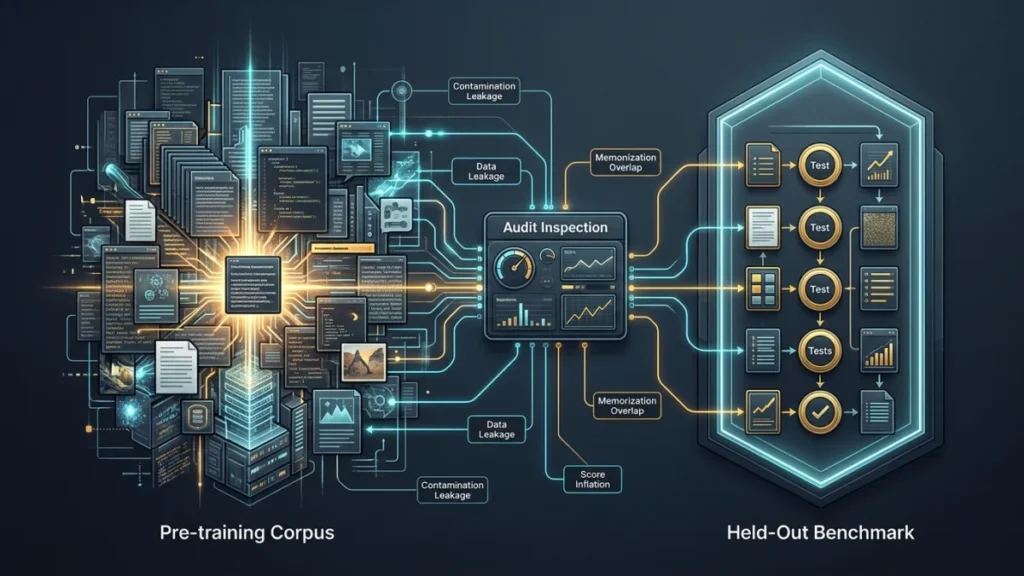
- Exposure and contamination: Public questions, close variants, or solution patterns may appear in training data. A score can partly reflect familiarity rather than transferable skill.
- Reliability: An average score can hide rare but costly failures. High-stakes use depends on calibration, consistency, and recovery when conditions change.
- System dependence: Results may rely on tools, repeated sampling, large inference budgets, scaffolding, or human selection. Those choices are valid, but they must be disclosed.
Longer-horizon evaluations add another dimension. Completing a multi-hour or multi-day task requires planning, memory, error detection, and adaptation. Even then, performance in a controlled environment does not automatically establish safe, economical, or robust operation in the world. The strongest conclusion should match the test: success on a coding benchmark supports a coding-capability claim, not a universal-intelligence claim.
Why forecasts disagree
Predictions about AGI and ASI are built from different assumptions. Fast timelines often assume continued scaling, better reasoning methods, more efficient compute, improved agents, and rapid automation of AI research. Slower timelines give more weight to unreliable reasoning, scarce high-quality data, energy and hardware constraints, embodiment, long-horizon errors, security, and the possibility that new scientific ideas are required.
The disagreement is not resolved by averaging dates. Expert forecasts can identify scenarios, but they do not create evidence that the forecasted system exists. Company leaders also have strategic incentives that may shape public language, while skeptics may underestimate discontinuous progress. Both kinds of statements should be labeled as opinion or projection.
A 2026 DeepMind report on possible paths from AGI to ASI describes several pathways, including scaling, paradigm shifts, recursive improvement, and multi-agent systems. It also emphasizes large uncertainties and possible bottlenecks. That is a better model for the discussion: multiple conditional pathways, not a guaranteed jump on a fixed date.
What the comparison means in practice
Organizations do not need to settle the ASI timeline before making good AI decisions. They need to evaluate the system they can deploy now.
- Define the job and failure cost. “Use AI” is not a requirement. Specify the task, expected inputs, acceptable error, escalation path, and consequences of a wrong output.
- Test the deployed system. Evaluate the model with its retrieval, tools, permissions, user interface, and human workflow. Include realistic edge cases and adversarial inputs.
- Measure more than accuracy. Track calibration, consistency, security, privacy, latency, cost, drift, and the rate at which people detect and correct errors.
- Limit autonomy by evidence. Grant permissions according to demonstrated reliability and reversibility. A fluent explanation is not proof that an action is safe.
- Keep human accountability. High-impact decisions still need named owners, audit trails, and a way for affected people to challenge outcomes.
The NIST AI Risk Management Framework Core organizes this work around govern, map, measure, and manage. Those functions apply to current systems. They remain useful whether AGI appears soon, much later, or never meets a single agreed definition.
Readers should apply the same discipline to vendor claims. Ask which tasks were tested, whether results were independently replicated, what tools and compute were used, how often the system fails, and whether it transfers to new conditions. A claim that cannot answer those questions should not be upgraded by adding the word “superintelligent.”
What evidence would change the assessment
The assessment should change if the evidence changes. Important signals would include consistent cross-domain transfer with little task-specific tuning, sustained autonomous completion of unfamiliar long-horizon work, reliable self-correction under distribution shift, and independent replication across institutions. Researchers would also need transparent evaluation methods that make data exposure, tool use, compute budgets, and failure rates visible.
No single signal would settle every philosophical question about intelligence or consciousness. Together, however, they would support a stronger empirical case than selected benchmark wins or demonstrations. Extraordinary labels require evidence that is broad, repeatable, and proportionate to the claim.
How to assess the next claim
Current AI deserves serious investment and serious governance because its present capabilities already affect work, security, information, and decision-making. AGI and ASI deserve research and preparedness, but they should remain clearly labeled as proposed or hypothetical categories until evidence establishes otherwise. The sound approach is neither dismissal nor certainty: measure what systems can do, expose what they cannot do, and update the judgment when independently verified capabilities change.