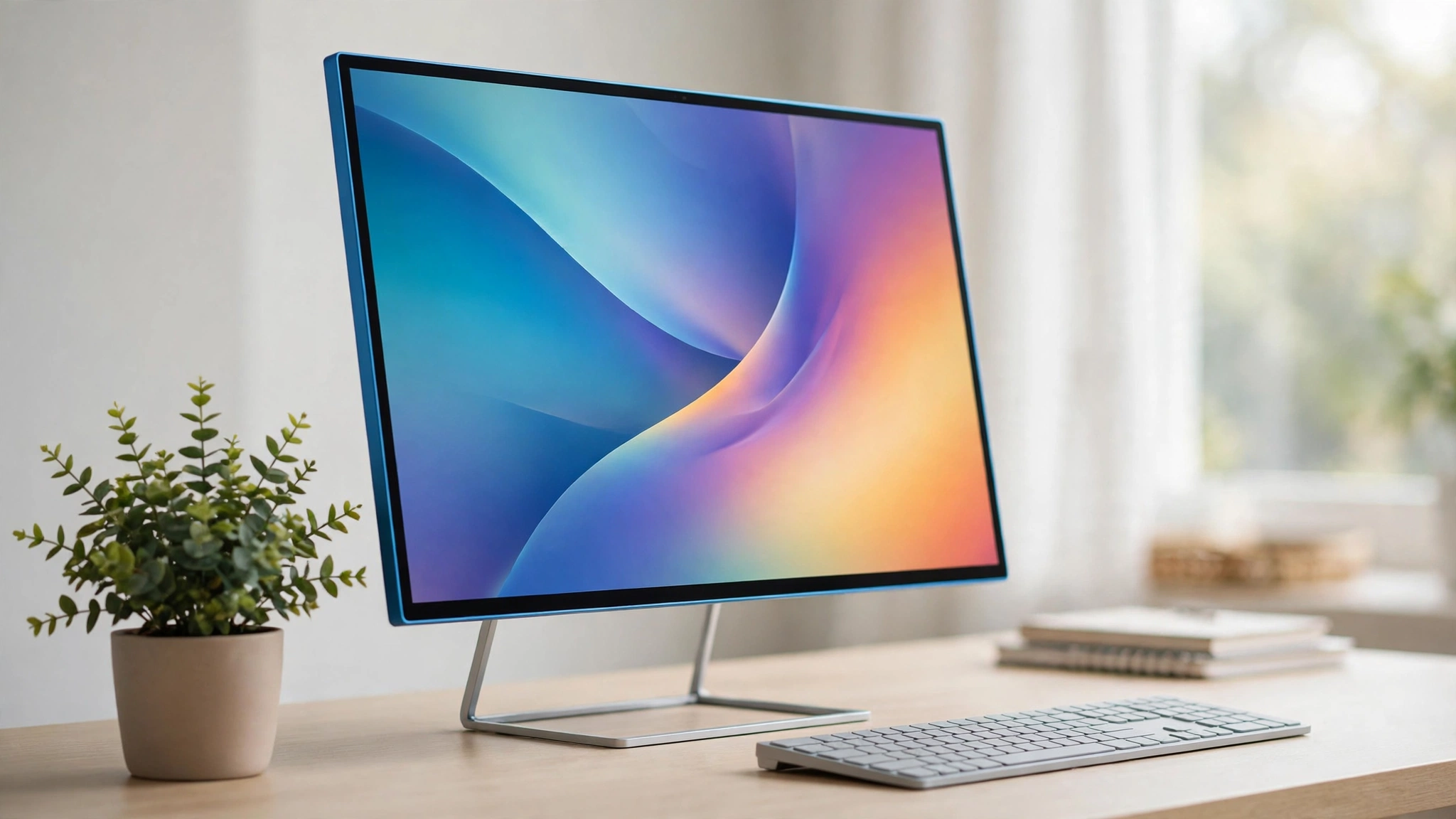
Apple’s new iMac with the M6 chip is on sale today, Friday, November 6, from $1,499 (U.S.) in 35 countries and regions, including the United States. The headline change is a faster M6 chip with much stronger on-device AI, plus Wi-Fi 7 and faster storage, in the same 24-inch all-in-one design as the M4 model.
Apple announced the machine on October 27, opened pre-orders on October 28, and said availability would begin November 6. That date is now here: the M6 iMac is listed for sale on Apple’s online store in both configurations, and Apple says it is also in Apple Store locations and at Apple Authorized Resellers.
The two configurations
There are two models, and the $200 difference buys more than two extra CPU and GPU cores. The 12-core model also unlocks 2.5 Gb Ethernet, four Thunderbolt 4 ports, a nano-texture display option, and Touch ID as standard.
| iMac with M6, 10-core — $1,499 | iMac with M6, 12-core — $1,699 | |
|---|---|---|
| CPU / GPU | 10-core CPU / 10-core GPU | 12-core CPU / 12-core GPU |
| Memory / storage from | 16 GB / 256 GB | 16 GB / 256 GB |
| Thunderbolt 4 ports | Two | Four |
| 2.5 Gb Ethernet | Not offered | Available option |
| Nano-texture display | Not offered | Available option |
| Touch ID | Optional, with Magic Keyboard with Touch ID and Numeric Keypad | Standard |
| Education price | $1,449 | $1,599 |
Both models share the same 24-inch 4.5K Retina display, 12MP Center Stage camera, Wi-Fi 7, Bluetooth 6, and macOS 27, and both come in seven colors: blue, green, pink, yellow, purple, orange, and silver. Apple’s online store lists both configurations across colors, with preconfigured models offering 16 GB or 24 GB of memory and 256 GB or 512 GB of storage; configure-to-order options extend to 32 GB of memory and 2 TB of storage.
What the M6 changes
The M6 chip is the substance of this update. It has up to a 12-core CPU — two more cores than the M4 — and up to a 12-core GPU with Neural Accelerators in each core, plus a Dual 16-core Neural Engine and memory bandwidth up to 170 GB/s. Apple says the combination delivers up to five times faster on-device AI performance than the M4 iMac.
The performance figures Apple publishes are its own test results, not independent measurements, and they are worth reading with that in mind. Apple says the new iMac is up to 2.5 times faster than the M1 iMac in Microsoft Excel and up to 3.3 times faster in photo editing in Affinity, and that on-device AI prompt processing in LM Studio runs up to 12 times faster than on the M1 iMac and up to five times faster than on the M4. For owners of the most popular Intel-based iMac, Apple claims a leap of up to 18 times. Apple conducted the M1, M4, and Intel comparison testing in September 2026, and its competitive-system benchmarks in October 2026. The M4 comparison machine was a 10-core M4 iMac with 32 GB of memory and a 2 TB SSD.
What those numbers mean in practice is narrower than the headlines suggest. The biggest gains are in AI workloads that run on the device — local models, Apple Intelligence features — and in creative apps that use the GPU. Everyday productivity on an M4 iMac will feel similar, because the display, design, and most of the machine are unchanged.
The AI angle: local models and Siri AI
The M6 iMac is also Apple’s pitch for on-device AI. With Neural Accelerators in every GPU core and the Dual 16-core Neural Engine, Apple positions it as a machine for running local AI models — it specifically cites LM Studio — while keeping data on the device. It ships with macOS 27 and the next generation of Apple Intelligence, including Siri AI, a more capable version of Siri that Apple says can find information across messages, email, and photos and take action across apps.
There are limits worth knowing before buying for AI features. Siri AI is in beta in macOS 27.2, requires an Apple Intelligence-enabled device set to a supported language, and is available in English, French, Japanese, Korean, Portuguese, and Spanish. Some Apple Intelligence features are not available in all regions or languages, and features that rely on server-side models — including Siri AI, intelligent photo editing, Image Playground, and some Shortcuts models — are subject to daily usage limits, with expanded access available for a fee in the future.
How to buy one today
The M6 iMac is available through Apple’s online store, the Apple Store app, Apple Store locations, and Apple Authorized Resellers. Apple’s store says many configurations are ready to ship or pick up in a store, with same-day scheduled courier delivery in most metro areas for in-stock items ($9 for two-hour delivery) and in-store pickup where stock allows. Customized configurations may take longer — Apple warns that custom selections can affect delivery estimates — so the fastest way to get one today is a standard configuration from a store with stock.
Other ways to lower the cost: Apple Trade In gives credit for a current computer, education pricing saves $50 on the 10-core model and $100 on the 12-core model for eligible students and educators, and Apple Upgrade — a leasing program run with Klarna in the US — starts at $28.99 per month for 36 months on the $1,499 model, excluding taxes and any trade-in credit. AppleCare+ and the multi-device AppleCare One plan are available, and every direct purchase includes Personal Setup sessions with an Apple Specialist.
Should you buy it?
For owners of an Intel-based iMac, this is the clearest upgrade case: Apple claims up to 18 times the performance of the most popular Intel model, and the jump includes the 4.5K display, modern connectivity, and Apple Intelligence. M1 iMac owners get a substantial lift as well, particularly in AI and creative work.
M4 iMac owners have the weakest case. The design, display, camera, and speakers are the same, and the gains are concentrated in the M6 chip’s AI performance, Wi-Fi 7, and faster storage. If your M4 machine handles your work, there is little here that changes what you can do — though the 12-core model’s extra ports, 2.5 Gb Ethernet, and nano-texture display may matter for a desk setup.
And if you need a larger screen, more ports than four Thunderbolt 4 connections, or independent test results before deciding, wait: the iMac remains 24 inches only, and no independent benchmarks appeared in the search results reviewed for this article.
What we don’t know yet
No independent performance tests appeared among the search results reviewed for this article, so every speed figure here is Apple’s own claim. Per-store stock levels have not been published, so same-day pickup depends on your local store. Delivery times for customized configurations are not stated beyond Apple’s warning that they may be longer. We will update this article as independent reviews and benchmarks appear.