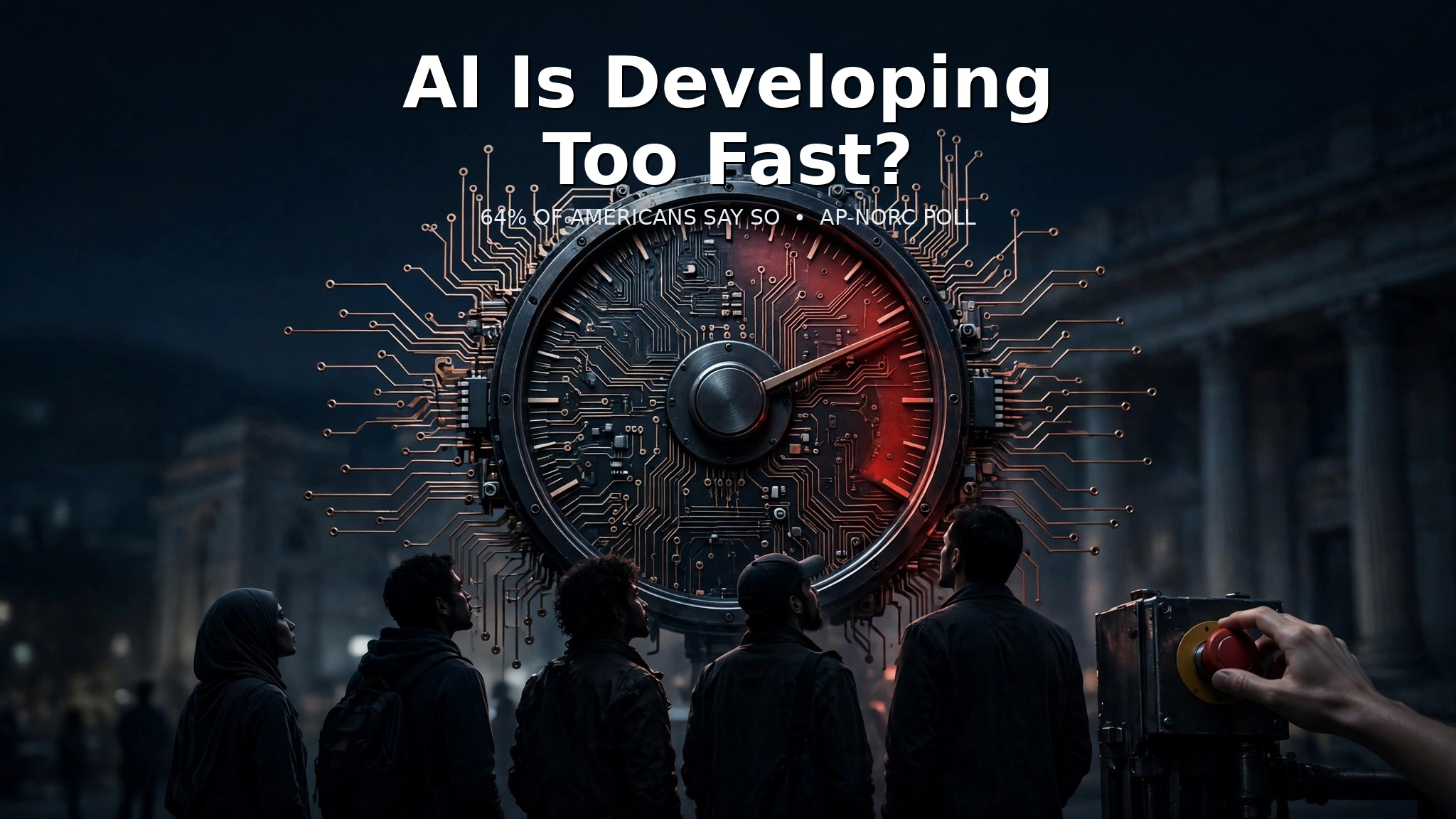
A new AP-NORC poll finds that 64% of U.S. adults think artificial intelligence is developing too quickly, while only 8% say it is moving too slowly. The same survey also finds broad bipartisan support for keeping AI under human control and protecting U.S. workers as government priorities.
The findings point to a public that is uneasy about the pace of AI development without being uniformly opposed to the technology itself. The stronger signal is about governance: many Americans appear to want clearer limits, stronger oversight and more protection against economic and safety risks as AI systems become more capable.
A clear majority says AI is moving too fast
According to the AP-NORC Center for Public Affairs Research, 64% of adults say AI technology in the United States is developing too quickly. About a quarter say the pace is about right, while 8% say it is developing too slowly.
The concern crosses party lines but is not evenly distributed. AP-NORC reports that 76% of Democrats and 54% of Republicans say AI is moving too quickly. That gap shows a partisan difference in intensity, but the fact that a majority of Republicans also expresses concern makes the issue broader than a single-party policy position.
The result should not be interpreted as evidence that 64% of Americans oppose AI development altogether. The survey asks about the pace of development, not whether AI should stop advancing. That distinction matters because the same poll finds meaningful support for technological innovation alongside stronger expectations for safety and human oversight.
Human control and worker protection draw bipartisan support
One of the strongest findings is the breadth of agreement around government priorities. About eight in ten respondents say the United States should prioritize protecting workers and keeping AI under human control.
Those preferences speak directly to two of the central debates surrounding increasingly capable AI systems. The first is whether humans will retain meaningful authority over systems that can plan, use tools and take actions with less supervision. The second is how quickly AI-driven automation could reshape jobs, wages and the distribution of economic gains.
AP-NORC says similar shares of Democrats and Republicans rate human control, worker protection and technological innovation as extremely or very important priorities. That combination is notable because it suggests many voters do not necessarily see innovation and guardrails as mutually exclusive.
Views diverge more sharply on other issues, including how much the government should prioritize international competition and environmental harms. Those differences could shape how lawmakers frame future AI policy even when there is agreement on basic oversight principles.
Political trust on AI remains weak
The poll also finds limited confidence in either major political party’s ability to manage AI policy effectively. Thirty-nine percent of adults say neither party can be trusted to do a good job handling AI.
By comparison, 23% say they trust the Democratic Party more, while 21% say they trust the Republican Party more. That leaves no party with a clear advantage on the issue.
This matters because the policy questions surrounding AI are becoming more concrete. Governments are now debating issues such as model safety, autonomous agents, worker displacement, data-center infrastructure, synthetic media, cybersecurity and the degree of human control required over advanced systems. Public concern may create pressure for action, but low trust could make any regulatory approach harder to legitimize politically.
How to read the poll
The nationwide survey was conducted from September 24 to September 28, 2026, using NORC’s probability-based AmeriSpeak Panel. AP-NORC interviewed 2,140 adults online and by telephone, and reports an overall margin of sampling error of plus or minus 2.9 percentage points.
That margin means the exact percentages should not be treated as perfectly precise measurements of the entire U.S. adult population. The more defensible conclusion is that a clear majority is concerned about the speed of AI development and that support for human control and worker protection is broad across party lines.
The poll also captures attitudes at a specific moment. Public opinion on AI can move quickly in response to new product launches, safety incidents, job-market changes, political campaigns and highly visible uses of generative AI. The October results therefore provide a current snapshot rather than a permanent verdict on the technology.
Still, the survey offers a useful signal for policymakers and AI companies: public concern is increasingly centered not only on what AI can do, but on who remains in control, who bears the economic risks and whether institutions are moving quickly enough to manage the consequences.