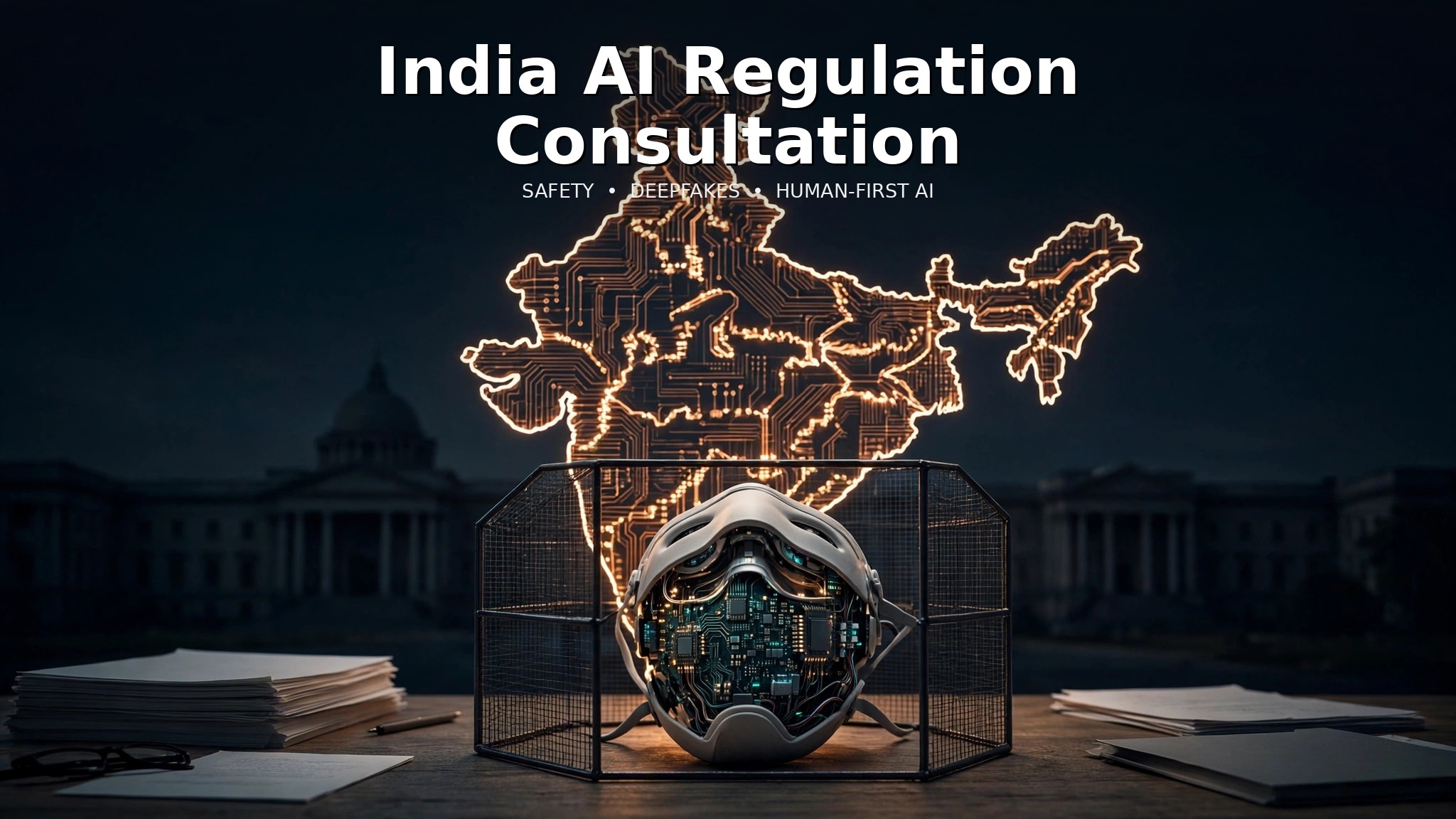
India will release a consultation paper on artificial intelligence regulation within the next month, with AI safety, cybersecurity, deepfakes and a “human-first” approach among the issues the government intends to examine. Electronics and IT Minister Ashwini Vaishnaw announced the move on October 8 while speaking at the India launch of the World Development Report 2026.
The announcement is significant because it signals a shift toward a broader national AI governance framework. It does not, however, mean India has already enacted a comprehensive AI law. The next step is a consultation document intended to gather views and shape the regulations that may follow.
India moves toward a broader AI regulatory framework
According to Akashvani News, Vaishnaw said the government plans to float the consultation paper within a month. He said the proposed document will focus on AI safety, cybersecurity, the benefits and potential harms of AI, and the need to protect people from harmful uses such as deepfakes.
That makes the consultation more expansive than a narrow deepfake rule or content-labeling measure. The government is signaling that it wants to consider how AI systems affect users, society and economic participation across several dimensions at once.
The legal status remains important. A consultation paper is a policy-development instrument, not a final statute or regulation. It can identify options, invite stakeholder feedback and define the questions a regulator wants answered, but it does not by itself create binding obligations for AI developers, platforms or users.
Safety, deepfakes and cybersecurity are central
Vaishnaw identified safety as the most important focus of the coming paper. Deepfakes are one of the clearest examples of the problem the government wants to address because synthetic media can be increasingly difficult for ordinary users to distinguish from authentic content.
Government broadcaster DD India reported that Vaishnaw described deepfakes as a social nuisance capable of creating false narratives and misleading people. The consultation is also expected to examine cybersecurity, user harm and psychological harms linked to AI use.
The framing suggests India is looking beyond model capability in the abstract. The policy discussion is moving toward the downstream effects of deployed systems: whether people can trust what they see, whether autonomous or semi-autonomous systems create new security risks, and whether users can be harmed even when a system is technically functioning as designed.
Vaishnaw also emphasized a “human-first” approach and skilling. That means the government is pairing safety concerns with an inclusion objective: AI policy should not only reduce harmful uses but also help people and smaller organizations benefit from the technology rather than be displaced or excluded by it.
Industry may carry more responsibility
One of the more consequential signals in the announcement concerns who is expected to manage AI risk. Vaishnaw said AI cannot be regulated through law alone and called for a “techno-legal” approach involving stakeholders.
He also said industry should take primary responsibility for issues including cybersecurity, safety, user harm, psychological disorders and deepfakes. If that principle survives into a formal framework, it could push more responsibility onto AI providers to build technical safeguards rather than treating compliance as a purely legal or disclosure exercise.
That could matter especially for fast-moving areas such as generative media, AI agents and systems that can take actions across external tools. Those categories create risks that may be difficult to address through static rules alone because model behavior, product capabilities and attack techniques change faster than legislation typically does.
What remains undefined
Many of the most important questions are still open. The government has not yet published the consultation paper, so there are no final definitions for high-risk AI, no confirmed liability framework, no announced enforcement mechanism and no settled obligations for developers, deployers or platforms.
It is also not yet clear whether India will create a single horizontal AI law, rely on sector-specific rules, expand existing digital-law mechanisms, or combine several approaches. The minister’s emphasis on a techno-legal framework suggests that technical standards and industry controls could sit alongside legal requirements, but the balance has not been defined.
The consultation will therefore be the document to watch. It should reveal whether India intends to regulate particular applications such as deepfakes and autonomous agents, impose duties based on risk levels, create transparency or incident-reporting requirements, or focus more heavily on voluntary safeguards and industry accountability.
For now, the material development is narrower but still important: India has formally signaled that a broader AI regulatory framework is coming onto the policy agenda, with safety, deepfakes, cybersecurity and human impact at its center.